
Table of Contents
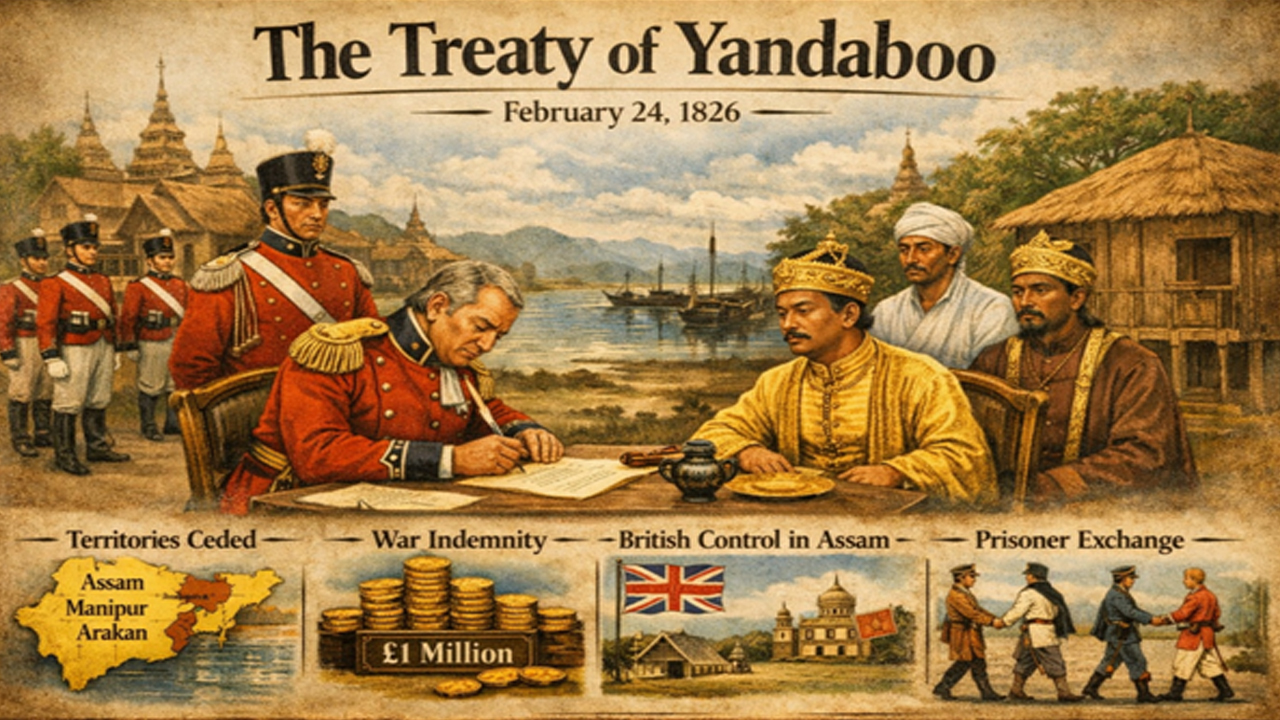
The Treaty of Yandaboo, signed on February 24, 1826, brought an end to the First Anglo-Burmese War (1824–1826). This decisive agreement between the British East India Company and the Kingdom of Burma (Konbaung dynasty) reshaped the political map of South and Southeast Asia. Ceding vast territories to Britain, it marked the decline of Burmese power and the beginning of colonial rule in Assam and Northeast India. The Treaty of Yandaboo was an important treaty that changed the history of this region completely.
Key Point:
- Signed on 24 February 1826
- Ended the First Anglo-Burmese War
- Between British East India Company and Burma’s Konbaung dynasty
Background and Causes of the First Anglo-Burmese War:
The First Anglo-Burmese War was triggered by Burmese expansion into Assam, Manipur, and the Bengal frontier, which clashed with British interests. The Konbaung dynasty sought to dominate the region, but Britain’s naval superiority and prolonged campaigns drained both sides. The war was extremely costly, with over 15,000 British casualties, making it one of the most expensive conflicts fought by the Company. By early 1826, British forces had advanced dangerously close to Ava, Burma’s capital, forcing the Burmese court to negotiate.
Geographic Area of Burma(Present-day Myanmar) in History:
The Burmese Konbaung dynasty (1752–1885) created one of the largest empires in mainland Southeast Asia, stretching across much of present-day Myanmar and expanding into Assam, Manipur, Arakan (Rakhine), and even waging wars against Siam (Thailand) and Qing China. At its peak, it was the second-largest empire in Burmese history.
Key Points:
- Burmese expansion into Assam, Manipur, and Bengal borders
- Konbaung dynasty sought regional dominance
- Over 15,000 British casualties
- British forces advanced near Ava
Assam’s Political Situation During the Treaty of Yandaboo:
- The Ahom dynasty, which had ruled Assam since the 13th century, was weakened by the Moamoria Rebellion (1769–1805) and repeated Burmese invasions.
- By the early 1820s, the Burmese had occupied Assam and installed puppet rulers, stripping the Ahom kings of real authority.
- The last recognized Ahom king was Purandar Singha, but he had been dethroned and exiled during the Burmese occupation.
- When the Treaty of Yandaboo was signed in 1826, Assam was under Burmese military control, not Ahom sovereignty.
Sign-in provisions of the Treaty:
The treaty was signed at Yandabo village, located about 80 km from Ava. On the British side, General Sir Archibald Campbell represented the East India Company, while Maha Min Hla Kyaw Htin, a Burmese governor, signed on behalf of the Konbaung dynasty. Facing imminent invasion, Burma accepted the terms without debate, reflecting the unequal power balance between the two sides.
Key Points:
- Venue: Yandabo village near Ava
- Signed by Sir Archibald Campbell (British) and Maha Min Hla Kyaw Htin (Burma)
- Burma accepted the terms under military pressure
Key Provisions of the Treaty:
The treaty contained several clauses that drastically altered the region’s political landscape. Burma ceded Assam, Manipur, Arakan (Rakhine), and the Tenasserim coast to Britain. It agreed to pay an indemnity of £1 million in four installments, withdraw from Cachar and Jaintia Hills, and allow a permanent British Resident at Ava. Prisoner exchanges and commercial agreements were also mandated, further strengthening British influence.
Key Points:
- Territorial cessions: Assam, Manipur, Arakan, Tenasserim
- Indemnity: £1 million in four parts
- Withdrawal from Cachar and Jaintia Hills
- British Resident stationed at Ava
- Prisoner exchanges and trade agreements
Immediate Consequences for Assam and Burma:
The treaty ended the 600-year Ahom dynasty in Assam, ushering in British colonial rule without local consent. Assam and Manipur were integrated into British India, while Burma’s treasury was severely depleted, weakening the Konbaung dynasty and sparking internal unrest. The agreement marked the beginning of direct British control in Northeast India.
Key Points:
- End of the Ahom rule in Assam
- Assam and Manipur were annexed into British India
- Burma’s economy weakened
- Start of colonial administration in Northeast India
Also Read: Important Assam History MCQ for APSC Exam
Long-Term Significance for Assam, Burma, and India:
The Treaty of Yandaboo set the stage for further Anglo-Burmese conflicts, eventually leading to Britain’s complete conquest of Burma by 1885. For Assam, integration into British India transformed its economy through tea plantations and taxation systems, while administrative reforms reshaped governance. Socially, the treaty led to the decline of traditional nobility and the rise of new elites. Its legacy continues to influence the colonial history of India, Myanmar, and Bangladesh.
Key Points:
- Led to the Second and Third Anglo-Burmese Wars
- Britain conquered Burma fully by 1885
- Assam’s economy shifted to tea plantations and taxation
- Administrative restructuring under British officials
- Decline of nobility, rise of new elites
Conclusion:
The Treaty of Yandaboo (1826) was a turning point in South and Southeast Asian history. It ended the First Anglo-Burmese War, dismantled the Ahom dynasty, and ushered in British colonial rule in Assam. Its provisions reshaped regional politics, economy, and society, leaving a legacy that remains central to understanding colonial expansion in the Northeast.
Key Points:
- Watershed moment in Assam’s history
- Ended the First Anglo-Burmese War
- Began British colonial rule in Northeast India
- Shaped India-Myanmar-Bangladesh borders
FAQs on the Treaty of Yandaboo:
Q2. When was the Treaty of Yandaboo signed?
It was signed on 24 February 1826, marking the official end of the First Anglo-Burmese War.
Q3. What territories were ceded under the treaty?
Burma ceded Assam, Manipur, Arakan (Rakhine), and the Tenasserim coast to the British. It also withdrew from Cachar and Jaintia Hills.
Q4. What indemnity did Burma have to pay?
Burma agreed to pay £1 million sterling in four installments, which severely strained its economy.
Q5. What was the impact of the treaty on Assam?
The treaty ended the 600-year Ahom dynasty, integrated Assam into British India, and marked the beginning of colonial administration in the region.
Q6. What was the long-term significance of the treaty?
It paved the way for the Second (1852) and Third (1885) Anglo-Burmese Wars, leading to Britain’s complete conquest of Burma. For Assam, it transformed the economy, administration, and society under colonial rule.