
Table of Contents
Introduction :
The Hindu Marriage Act, 1955 brought India’s varied Hindu marriage practices into a single legal framework. It keeps the cultural and religious importance of marriage intact—recognising traditional ceremonies—while adding clear legal rules on who can marry, what makes a marriage valid, and what remedies are available when things go wrong (separation, divorce, alimony, child custody). In short, the Hindu Marriage Act, 1955 Act balances respect for custom with modern protections for individual rights, making marriage both a social ritual and a legally enforceable relationship.
1. Hindu Marriage Act, 1955 – Applicability & Features
Applicability (Secs 2) :
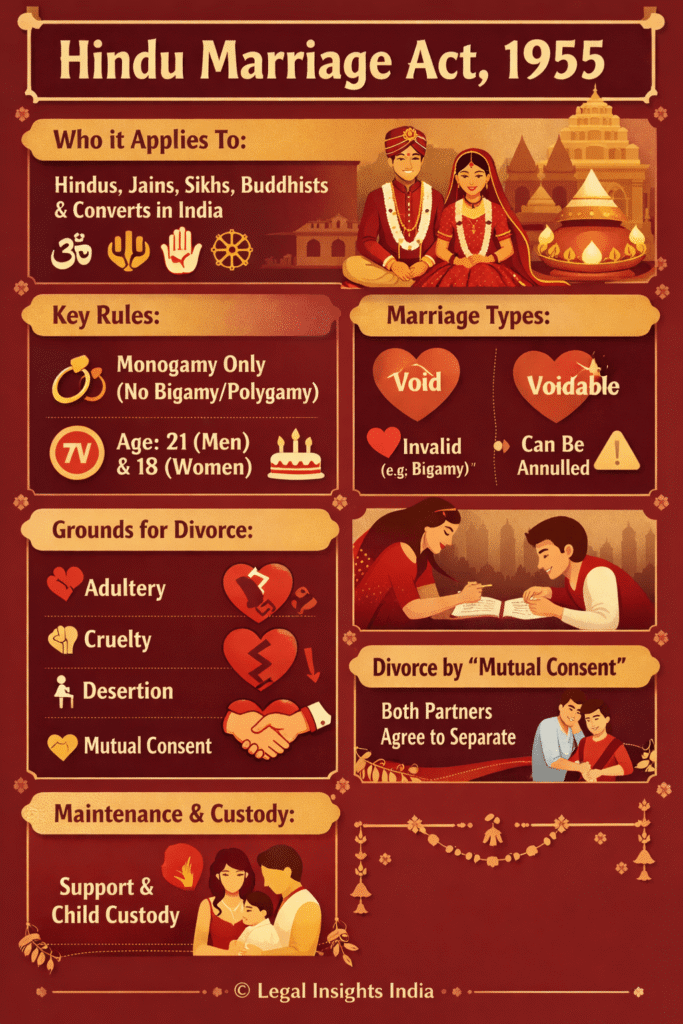
- Applies to Hindus (includes Buddhists, Jains, Sikhs), Virashaiva, Lingayat, Brahmo-Somaj, and persons who convert to Hinduism and are domiciled in India.
- Does not apply to Muslims, Christians, Parsis (their personal laws govern).
- Marriages under the Special Marriage Act follow that Act, not automatically HMA.
Salient Features :
- Conditions for valid marriage: monogamy, age (bridegroom 21, bride 18), mental capacity, free consent, no prohibited relationships.
- Void vs voidable marriages: incest/bigamy void; fraud/impotence may make marriage voidable.
- Restitution of conjugal rights, judicial separation provided.
- Grounds for divorce: adultery, cruelty, desertion (2 yrs), conversion, mental disorder, venereal disease, renunciation, presumption of death, mutual consent (Sec 13B).
- Courts can order maintenance, custody and alimony.
- Interacts with the Special Marriage Act, PWDV Act, Dowry Prohibition Act and judicial precedents.
2. Forms of marriage: Marriage as sacrament and marriage as contract :
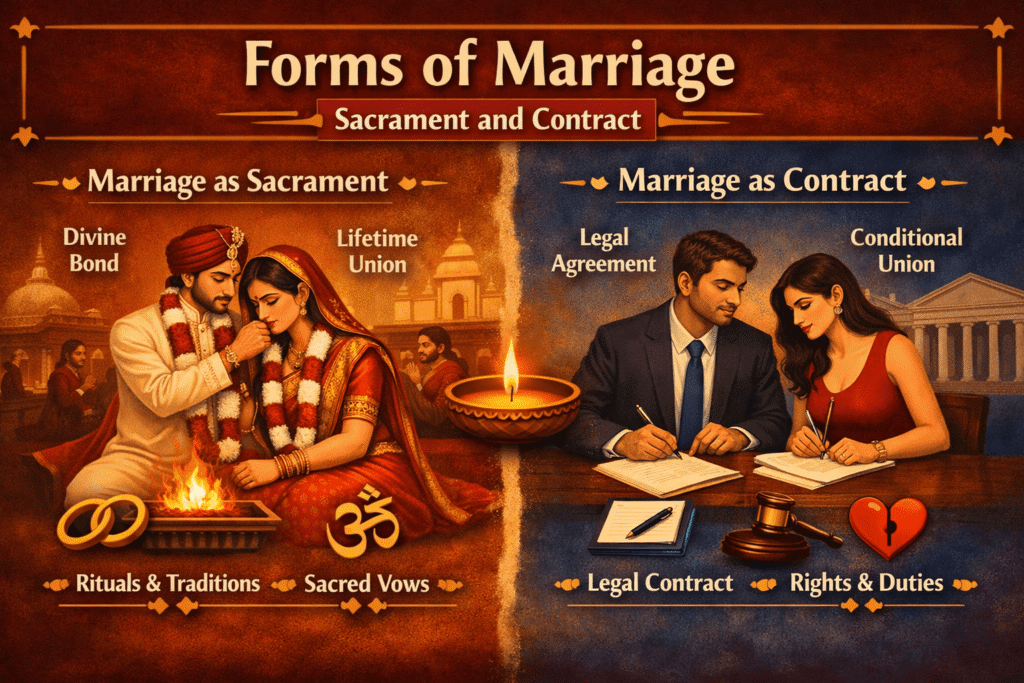
“Form of marriage” describes how societies and laws conceptualize marriage. Two principal models are marriage as a sacrament (religious, indissoluble union) and marriage as a contract (civil agreement creating legal rights and obligations). Indian law today reflects elements of both.
Marriage as Sacrament:
Marriage is seen as a sacred, religious bond ordained by divine or religious authority.
Core features:
- Sanctity and permanence: Considered permanent and morally binding; divorce is traditionally discouraged.
- Ritual-centred: Solemnization through religious rites and customs is central to validity and social recognition.
- Community and lineage focus: Emphasis on family continuity, caste/community norms, and duties beyond individual consent.
- Authority: Governed primarily by religious doctrine and customary practices rather than state law.
Legal relevance in India:
- Historically dominant in Hindu law, many customs received legal recognition.
- HMA, 1955, preserves ceremonial importance but subjects it to statutory conditions and remedies.
- Courts balance religious sentiments with statutory rights when adjudicating matrimonial disputes.
Marriage as Contract :
Marriage is treated as a civil contract entered into by the free consent of two adults, enforceable and terminable under law.
Core features:
- Consent and capacity: Free consent and legal capacity are essential; parties are treated as legally autonomous.
- Legal enforceability: Rights and obligations (maintenance, property, child custody) are enforceable in courts.
- Dissolubility: Marriage can be dissolved by judicial processes (divorce, judicial separation).
- Equality and secular regulation: Focus on individual rights and state regulation rather than religious dictates.
Legal relevance in India:
- Reflected in the Special Marriage Act, 1954 (secular, contractual framework for inter-faith and civil marriages).
- HMA, 1955, incorporates contractual elements — conditions for a valid marriage (age, consent, monogamy) and statutory grounds for divorce and maintenance.
3. Conditions of valid Hindu marriage (Sec 3 & 5):
Sections 3 and 5 of the Hindu Marriage Act, 1955 set out who may be married under the Act and the essential conditions for a valid Hindu marriage. Section 3 deals with definitions like custom, sapinda relationship, and degrees of prohibited relationship; Section 5 specifies the substantive conditions that must exist at the time of solemnization.
(Section 3)Definitions Section:
Section 3 is the definitions section of the Hindu Marriage Act, 1955. It explains important terms used in the Act, such as custom or usage, district court, full blood, half blood, uterine blood, sapinda relationship, and degrees of prohibited relationship.
These definitions are important because they help determine whether a Hindu marriage is valid, especially in cases involving customary practices and prohibited relationships.
(Section 5)Essential conditions for a valid Hindu Marriage:
A marriage between two Hindus is valid only if the following six conditions are satisfied at the time of solemnization:
a) Neither party has a spouse living
- Both parties must be single, i.e., not already married. Bigamy renders the marriage void as per Section 11.
b) Neither party is incapable of giving valid consent
- Consent must be free and informed. Consent is invalid if obtained by fraud, force, undue influence, or mistake. Mental incapacity affecting the understanding of marriage terms also negates valid consent.
c) Neither party is suffering from a mental disorder, making them unfit for marriage and procreation
- A mental disorder that renders a person unfit for marriage and procreation — or poses risk of harm to the other party — can invalidate the marriage. Courts consider medical evidence and the nature/severity of the disorder.
d) Neither party is subject to recurrent attacks of insanity or epilepsy (historical wording)
- The Act’s language refers to disorders that affect the capacity to perform marital obligations; courts interpret this in the context of current medical understanding.
e) The bridegroom has completed 21 years, and the bride is 18 years of age
- Age requirements are mandatory. Child marriages are voidable under Section 12(1)(c) if either party repudiates the marriage before turning 18 (bride) or within one year after attaining majority, subject to certain exceptions.
f) Parties are not within prohibited degrees of relationship unless permitted by custom
- Marriages within specified degrees of consanguinity and affinity are forbidden unless an established custom permits them. Prohibited degrees cover many close blood and certain in-law relationships; local customary exceptions may operate in some communities.
4. Ceremonies for Hindu marriage (Sec – 7):
Section 7 recognises that a Hindu marriage may be solemnized according to the customary rites and ceremonies of either party, including rites prescribed by the Vedas. The Act does not prescribe a single mandatory ritual.
Key points:
a) Customary rites valid: Marriages performed according to bona fide community or family customs are valid under Section 7.
b) No universal ceremony required: Whether a particular rite (e.g., saptapadi) is essential depends on the custom of the parties’ community.
c) Statutory conditions still apply: Performance of rituals does not override Section 5 requirements (age, consent, monogamy, mental capacity, prohibited degrees).
d) Burden of proof: The party relying on a custom must prove its existence and acceptance (witnesses, community practice, documentary evidence).
e) Vedic rites included: The statute explicitly accepts Vedic ceremonies as valid modes of solemnization.
5. Registration of marriage (Sec – 8):
This Section 8 Act encourages registration; a marriage may be registered according to the law for the time being in force, i.e., under relevant State rules/registration Acts. HMA does not compulsorily mandate registration nationwide.
Key points:
- Legal position: Registration is permissive (not compulsory under HMA), but many states have made registration mandatory by separate rules/acts. Check state law where marriage is solemnized.
- Purpose and benefits:
a) Conclusive evidence: Registered marriage provides strong proof of marriage and date.
b) Easier access to legal remedies: Helps in claims for maintenance, succession, visa, passport, and social benefits.
c) Prevents disputes: Reduces proof issues in courts (less reliance on witnesses/ceremonial evidence).
6. Restitution of conjugal rights (Sec – 9):
Either spouse may apply to the district court for a decree of restitution of conjugal rights when the other spouse has withdrawn from cohabitation without reasonable cause.
Purpose: To restore matrimonial cohabitation and reconcile spouses by legally compelling resumption of marital life (not to force physical intimacy beyond consent).
Essentials (must be proved by claimant):
- Valid marriage exists.
- Respondent has withdrawn from cohabitation.
- Withdrawal is without reasonable cause.
- Plaintiff remains willing to live with respondent.
Court powers and relief:
- The court may grant a decree ordering the respondent to resume cohabitation.
- No power to force physical intercourse; contempt proceedings may follow if the decree is disobeyed.
- A decree is enforceable as a civil order; disobedience can lead to contempt of court.
Legal limitations and defences:
- Reasonable cause (e.g., cruelty, risk to health/safety, adultery) is a valid defence.
- Consent and personal liberty: Courts respect individual autonomy; restitution does not override the right to refuse sexual relations.
- Human Rights/constitutional issues: Courts balance marital restitution with fundamental rights to privacy and dignity.
- Subsequent relief: A decree for restitution can be used as ground for divorce (e.g., continued refusal may support cruelty/desertion claims).
7. Judicial Separation (Sec – 10):
Either spouse may present a petition to the district court for a decree of judicial separation on the same grounds as for divorce. A decree of judicial separation allows spouses to live apart legally without dissolving the marriage.
- Purpose: Provides a legal remedy short of divorce to relieve spouses from marital obligations (cohabitation) while marriage remains intact; can preserve social/religious status and allow time for reconciliation.
- Grounds: Same as for divorce (e.g., cruelty, adultery, desertion, conversion, mental disorder, venereal disease, renunciation, presumption of death, mutual consent procedures differ).
- Effect of decree:-
- Legal separation: Parties are entitled to live apart; cohabitation is no longer obligatory.Maintenance: Either spouse may seek maintenance during and after separation; a decree may be considered in maintenance proceedings. No dissolution: Marriage remains valid; spouses cannot remarry.
- Consequences and legal implications:
- Grounds for divorce later: Continued separation under a judicial separation decree can be relied upon for divorce (e.g., desertion ground) or used as evidence in subsequent proceedings.
- Legitimacy and status: Children’s legitimacy and inheritance rights remain unaffected by judicial separation.
- Reconciliation: Parties can resume cohabitation; reconciliation may annul the effects of the decree (court may record reconciliation).
Void and Voidable marriage (Sec – 11, 12, 17, 18)-
The Act distinguishes marriages that are null from the beginning (void) and those that are valid unless annulled (voidable). Consequences, grounds and remedies differ.
I. Void Marriage (Section 11)
A marriage that is void ab initio — it has no legal effect from the start.
- Main grounds (examples under HMA / general law):
- Bigamy: Either party has a spouse living at the time of marriage. Prohibited degrees: Marriage within specified consanguinity/affinity where no custom permits it.Other statutory disqualifications (where applicable).
- Consequences:
- No need for annulment; marriage is treated as non-existent legally. Parties cannot seek divorce (since no valid marriage), but may seek a declaration of nullity or ancillary reliefs where allowed.
- Children’s legitimacy: Generally legitimate if born in a void marriage where parents believed marriage valid (subject to specific statutes/case law).
II. Voidable Marriage (Sections 12, 17, 18)
A marriage valid until annulled by a court on specific grounds; only an aggrieved party can seek annulment within statutory limits.
Section 12 lists typical voidable grounds:
- Consent obtained by coercion, fraud, or mistake.
- Either party was a lunatic or an idiot at the time of marriage (unsoundness of mind), which prevented understanding of marriage.
- Marriage is consummated by force or incapacity (e.g., impotence) in certain contexts.
Sections 17 & 18 (effects of decree of nullity/annulment):
- Section 17: Court’s powers on decree of nullity — may grant custody of children and make orders for maintenance and expenses of proceeding.
- Section 18: Consequences of decree of nullity — court may declare the marriage null and make ancillary orders (custody, maintenance, costs). The legitimate status of children is protected in many contexts.
Time limits and procedural points:
- The petition must be filed by the aggrieved party; some grounds have statutory time bars or conditions (e.g., repudiation by a minor within a limited time).
- If the aggrieved party continues cohabitation after discovering the ground (e.g., fraud), courts may infer waiver or ratification.
9. Divorce (Sec – 13(1), (2), 13A, 13B and 15):
Section 13(1): Lists the general grounds for divorce, such as adultery, cruelty, desertion for two years, conversion, mental disorder, venereal disease, renunciation of the world, and presumption of death.

Section 13(2): Gives special grounds available only to the wife, including the husband having another wife, his guilt of rape/sodomy/bestiality, non-resumption of cohabitation after a maintenance decree, and repudiation of marriage in the cases provided by law.
Section 13A: Allows the court, in some divorce proceedings, to grant judicial separation instead of divorce.
Sec 13B — Mutual Consent Divorce:
- Allows divorce by mutual consent when both parties jointly petition and have been living separately for one year or more, and have mutually agreed that the marriage should be dissolved.
- Procedure: Joint petition, cooling-off period of six months (judicial discretion may waive/reduce), the court ensures settlement on alimony, maintenance, and custody before the decree.
- Faster, less adversarial route; court records that reconciliation attempts were made.
10. Sec 15 — Judicial separation as ground for divorce in certain circumstances:
If a decree for judicial separation has been obtained and the parties have lived apart for a specified period, this may be a ground for divorce under related
Key points:
- Burden of proof: Petitioner must prove the factual basis of the chosen ground (e.g., adultery, cruelty, desertion).
- Cruelty: Broadly interpreted to include physical and mental cruelty; often factual and context-specific.
- Desertion: Continuous withdrawal of cohabitation without consent and without reasonable cause, typically for two years as per Sec 13(1).
- Presumption of death: If a spouse has not been heard from for seven years, presumption of death may support divorce.
- Maintenance & custody: Courts decide ancillary reliefs (alimony, maintenance, custody) while granting divorce.
Legitimacy of children of void and voidable marriage (Sec – 16):
Section 16 protects legitimacy: A child born to a woman during a marriage (whether the marriage is void or voidable) is deemed legitimate, unless paternity is proved otherwise.
Also read: Uniform Civil Code: Key Insights and Implications
Scope and effect:
- Applies to children born while the parents are married or within the subsisting of marriage-related presumptions — legitimacy is presumed despite defects in the marriage.
- Protects children’s rights to maintenance, succession, inheritance and social status irrespective of the legal validity of the parents’ marriage.
Key points:
- Legitimacy despite defect: Even if the marriage is void ab initio (e.g., bigamy, prohibited degree) or voidable (e.g., consent vitiated by fraud) the child is legitimate under Sec 16 so long as born during the marriage.
- Rebuttable presumption: Legitimacy is a legal presumption and can be rebutted by evidence proving non-paternity.
- Protection of child’s interests: Courts prefer to safeguard the child’s welfare; Section 16 prevents children from being penalised for parental defects.
- Interaction with other laws: Section 16 operates subject to specific provisions elsewhere (e.g., evidence of non-access or proof of paternity). Where other statutes provide otherwise, those provisions may apply but courts generally uphold legitimacy for welfare reasons.
12. Maintenance ‘pendente lite’ and permanent alimony (Sec – 24 & 25):
Sec 24 — Pendente lite (interim):
- Meet immediate needs and litigation expenses while the matrimonial suit is pending.
- Who: Either spouse can claim; commonly granted to the wife.
- Quantum & duration: Discretionary; based on parties’ income, standard of living, needs, liabilities; payable during proceedings and adjustable against final decree.
- Enforcement: Decrees enforceable like civil orders; non‑payment may invite contempt.
Sec 25 — Permanent alimony & maintenance:
- Provide long‑term support after divorce or nullity.
- Who: Usually, the wife but available to either spouse if justified.
- Form & quantum: Periodical payments or lump sum, or transfer of property; discretionary assessment based on income, earning capacity, duration of marriage, age, health, standard of living, childcare needs, and conduct (not an absolute bar).
- Duration & alteration: May be commuted, varied on changed circumstances; ends on death of either party or remarriage of recipient (subject to court order).
Custody of Child (Sec – 26):
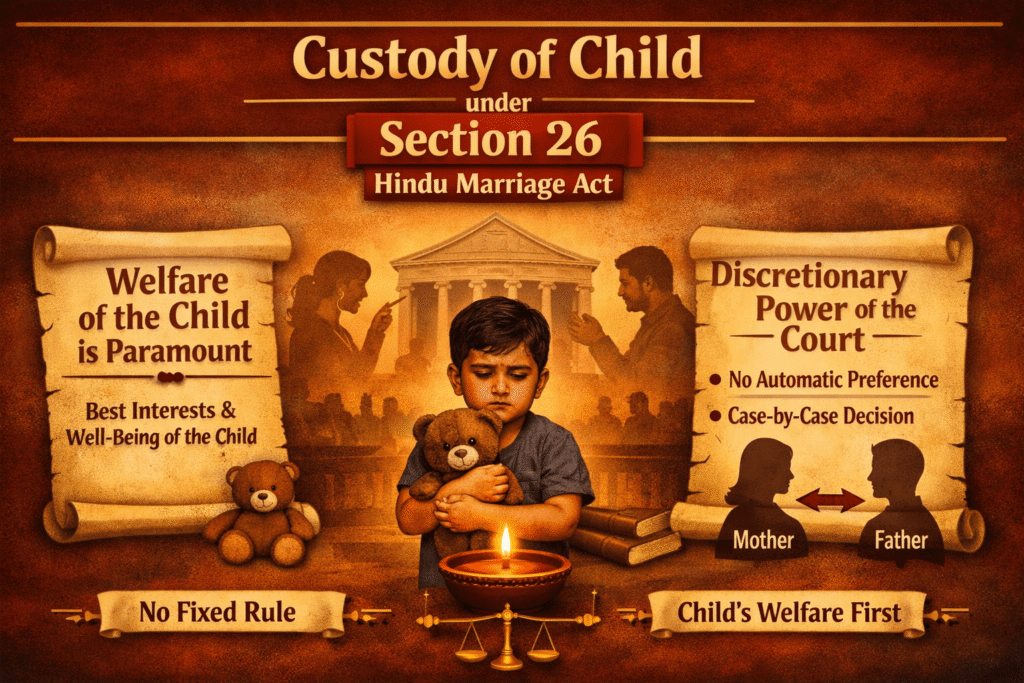
Section 26 empowers the court to make orders as to the custody, maintenance and education of children of the marriage when issuing a decree for judicial separation, nullity or divorce. Its primary principles are-
a) Welfare of the child: The child’s welfare is the paramount consideration in all custody decisions.
b) Discretionary power: Court decides custody based on facts — no rigid rule favouring either parent.
Factors courts consider:
- Age and sex of the child (young children often placed with mother; welfare test overrides strict age rule).
- Physical and mental health of parents and child.
- Parents’ moral character and conduct (only insofar as it affects the child’s welfare).
- Child’s wishes (given weight according to age and maturity).
- Parents’ capacity to provide proper care, education and environment.
- Stability and continuity: Which parent provides a stable home and preserves the child’s routine?
- Employment and availability of parents; ability to meet financial needs.
- Religious and cultural background (only if relevant to welfare).
- Any history of domestic violence or neglect.
Types of custody orders:
- Physical custody: With whom the child lives (primary caregiver).
- Legal custody: Who has the authority to make major decisions (education, medical treatment).
- Joint custody / shared custody: Courts may order shared arrangements when suitable.
- Visitation (access) rights: Non-custodian parent usually granted reasonable access, subject to the child’s welfare and safety.
14. Conclusion:
The Hindu Marriage Act, 1955 modernises and codifies Hindu matrimonial law by combining religious customs with statutory rules to govern marriage, its validity, dissolution and ancillary reliefs. Key aims are to define who is governed by the Act, set essential conditions for a valid marriage (age, consent, mental capacity, monogamy, prohibited degrees), recognise customary ceremonies, and provide remedies—restitution of conjugal rights, judicial separation, annulment, divorce (including mutual consent), and orders for maintenance, alimony and child custody.