
Table of Contents
1. Introduction -What are Directive Principles of State Policy (DPSP)?
Directive Principles of State Policy (DPSP) are non‑justiciable guidelines in Part IV of the Indian Constitution (Articles 36–51) that direct the State to establish a welfare society based on justice, equality, and good governance.
Basic meaning
DPSPs are non‑justiciable ideals, i.e., they cannot be directly enforced in courts, but they are “fundamental in the governance of the country”, and the State is expected to keep them in mind while framing laws and policies. They aim to promote social, economic and political justice, reduce inequalities, and move India towards a welfare state rather than a purely political democracy.
Non‑Justiciable but Fundamental in Governance
Directive Principles of State Policy (DPSP) are non‑justiciable, meaning their provisions cannot be directly enforced in a court of law, and citizens cannot move to the judiciary if the State fails to implement them.
At the same time, they are fundamental in the governance of the country, so the State is constitutionally expected to keep these principles in mind while making laws, framing policies, and designing welfare schemes. This combination—non‑justiciable yet fundamental—makes DPSP a guiding conscience for establishing a just, equitable, and welfare‑oriented society rather than a mere political democracy.
2. Constitutional Basis-Articles 36–51, Article 37, Irish Influence.
- Articles 36–51 in Part IV of the Indian Constitution.
- Article 37: DPSPs are not enforceable by courts but fundamental in governance.
- Sources: Inspired by the Irish Constitution (which borrowed from the Spanish Constitution).
The Directive Principles of State Policy (DPSPs) are contained in Part IV of the Indian Constitution, from Articles 36 to 51. These provisions lay down the fundamental guidelines for the governance of the country.
- Article 36 defines the term “State” for the purpose of DPSPs.
- Article 37 clarifies that DPSPs are non‑justiciable (not enforceable by courts) but are fundamental in the governance of the country.
- Articles 38 to 51 enumerate various principles, such as promoting social and economic justice, organizing village panchayats, securing a uniform civil code, protecting the environment, and promoting international peace.
Thus, the constitutional basis of DPSPs lies in Part IV (Articles 36–51), which provides a framework for the State to establish a welfare society and ensure justice, equality, and good governance.
3. Classification of DPSPs (Socialist, Gandhian, Liberal ‑Intellectual)
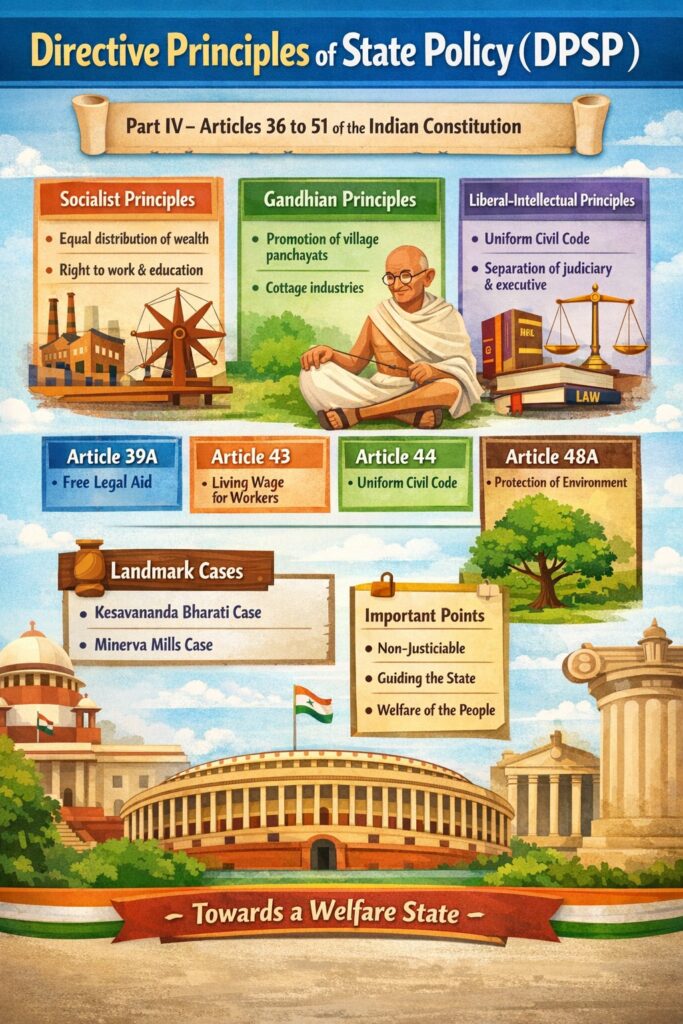
The Directive Principles of State Policy (DPSP) are generally classified into three broad categories for better clarity and understanding in exams.
a) Socialist Principles
These aim at establishing a social‑welfare and socialist economic order by reducing inequalities and ensuring social justice.
- Article 38: The State shall strive to promote the welfare of the people and secure a social order with minimal inequalities.
- Article 39: Directs the State to secure adequate livelihood, equal pay for equal work, ownership/ control of material resources for the common good, and to avoid concentration of wealth.
- Article 39A: Promotes equal justice and free legal aid to the poor.
- Article 41: Right to work, education, and public assistance in cases of unemployment, old age, sickness, etc.
- Article 42: Just and humane conditions of work and maternity relief.
- Article 43: Living wage and decent standard of life for workers.
- Article 43A: Participation of workers in the management of industries.
- Article 43B: Promotion of cooperative societies.
b) Gandhian Principles
These reflect Gandhian ideals such as a village‑based economy, promotion of cottage industries, and protection of weaker sections.
- Article 40: Organization of village panchayats as units of self‑government.
- Article 43: Promotion of cottage industries and small‑scale industries in rural areas.
- Article 46: Promotion of educational and economic interests of Scheduled Castes, Scheduled Tribes, and weaker sections; protection from exploitation.
- Article 47: Improvement of public health and prohibition of intoxicating drinks and drugs.
- Article 48: Organization of agriculture and animal husbandry on modern and scientific lines and protection of cattle.
c) Liberal‑Intellectual Principles
These are general, liberal‑democratic ideals borrowed from Western constitutional thought and international norms.
- Article 44: Secure a Uniform Civil Code for all citizens.
- Article 45: Provision for early childhood care and education for children below six years (earlier more broadly linked to free and compulsory education).
- Article 48A: Protection and improvement of the environment and safeguarding forests and wildlife.
- Article 49: Protection of monuments and places of national importance.
- Article 50: Separation of the judiciary from the executive.
- Article 51: Promotion of international peace and respect for international law and settlement of disputes by arbitration.
4. Key Articles of DPSP for Exams
These articles are especially important for exams because they capture core socio‑economic and governance goals of the DPSP:
- Article 39(b): The State shall direct its policy towards securing that the ownership and control of material resources of the community are so distributed as to best serve the common good.
- Article 39(c): The State shall ensure that the operation of the economic system does not result in the concentration of wealth and means of production to the common detriment.
- Article 41: The State shall, within the limits of its economic capacity, make effective provision for securing the right to work, to education, and to public assistance in cases of unemployment, old age, sickness, and disablement.
- Article 43: The State shall endeavour to secure, by suitable legislation or economic organisation or in any other way, to all workers a living wage, conditions of work ensuring a decent standard of life, and full enjoyment of social and cultural opportunities.
- Article 44: The State shall endeavour to secure for all citizens a Uniform Civil Code throughout the territory of India.
- Article 48A: The State shall endeavour to protect and improve the environment and to safeguard forests and wildlife (this was added by the 42nd Constitutional Amendment Act, 1976).
5. Amendments to DPSP – 42nd and 44th Amendment
These constitutional amendments modified Fundamental Rights and strengthened the role of Directive Principles of State Policy in governance.
a) 42nd Amendment Act (1976)
This amendment is often called the “Mini‑Constitution” because it significantly expanded DPSPs and added three new principle‑oriented articles:
- Article 39A: Added the directive to secure equal justice and free legal aid to ensure that opportunities for justice are not denied to any citizen due to economic or other disabilities.
- Article 43A: Added the directive on participation of workers in the management of industries, emphasizing labour welfare and industrial democracy.
- Article 48A: Added the directive to protect and improve the environment and safeguard forests and wildlife, making environmental protection an explicit constitutional goal.
b) 44th Amendment Act (1978)
This amendment was passed to roll back some excesses of the Emergency period and rebalance rights and directives:
- It reduced the scope of the right to property (removing it from the list of Fundamental Rights and making it only a legal right under Article 300A).
- By downgrading property from a Fundamental Right, it cleared the way for more social‑welfare legislation and strengthened the ability of the State to rely on DPSPs (e.g., land reforms, redistribution, and public‑welfare schemes) without fear of easy judicial strike‑down on property‑rights grounds.
What is the Preamble of the Constitution of India?
6. Relationship with Fundamental Rights-
The Directive Principles of State Policy (DPSP) and Fundamental Rights are complementary and mutually reinforcing parts of the Indian Constitution, but they differ in their legal nature and enforceability.
Key differences
- Fundamental Rights (Part III) are justiciable, meaning citizens can directly approach courts if the State violates them.
- DPSPs (Part IV) are non‑justiciable guiding principles; they cannot be enforced in court, but the State is expected to keep them in mind while framing laws and policies.
How they relate
- DPSPs provide the social and economic goals that Fundamental Rights help to secure (e.g., right to equality and right to life), supporting the socialist and Gandhian ideals in DPSP.
- Over time, the Supreme Court has used the “harmony theory” to balance the two, holding that Fundamental Rights and DPSPs should be interpreted together, and that DPSPs can justify reasonable restrictions on some rights when promoting larger public welfare (as seen in key cases like Minerva Mills).
7. Judicial Interpretation of DPSP-
Indian courts have gradually built a bridge between DPSPs and Fundamental Rights, treating them as part of a single constitutional vision rather than rivals.
a) Kesavananda Bharati v. State of Kerala (1973)
- The Supreme Court held that there must be harmony between Fundamental Rights and DPSPs.
- The Court ruled that Parliament can amend Fundamental Rights to implement DPSPs, but not so as to destroy the “basic structure” of the Constitution.
b) Minerva Mills v. Union of India (1980)
- The Court declared that the harmony between Part III (Fundamental Rights) and Part IV (DPSP) is itself a part of the basic structure.
- It emphasized that DPSPs are “fundamental in the governance of the country” and that neither Part III nor Part IV should be allowed to dominate the other.
c) Unnikrishnan v. State of Andhra Pradesh (1993)
- The Court interpreted Article 45 (DPSP on education) as giving rise to a fundamental right to education up to a certain age.
- It held that the right to education is implicit in the right to life under Article 21, derived and strengthened by DPSPs, until a specific constitutional amendment was made (later realised through the 86th Amendment and Article 21A).
8. Criticism & Limitations of DPSP-
Despite their importance, the Directive Principles of State Policy face several criticisms and practical limitations:
- Non‑justiciable nature: DPSPs cannot be enforced in courts, so citizens have no legal remedy if the State fails to implement them, making them more like political promises than binding obligations.
- Dependence on political will: Actual implementation depends heavily on the government’s ideology, priorities, and availability of resources, so many DPSPs remain on paper when they conflict with immediate political or economic interests.
- Often ignored in practice: In many cases, laws and policies are shaped more by short‑term political calculations, budget constraints, or powerful interest groups, causing key DPSPs (like equitable distribution of resources, workers’ welfare, or Uniform Civil Code) to be delayed, diluted, or neglected.
9. Conclusion
Directive Principles of State Policy (DPSP) form the moral and social‑policy backbone of the Indian Constitution, guiding the State toward a just, equitable, and welfare‑oriented society. While they are non‑justiciable and depend on political will and adequate resources for implementation, DPSPs have significantly influenced laws on workers’ rights, environment, education, and social justice. In competitive‑exam answers, they are best used to show how Fundamental Rights and DPSP together help transform India into a welfare State, balancing individual liberties with broader social goals.
Frequently Asked Questions (FAQ)
Q2. Are DPSPs justiciable?
No, DPSPs are non‑justiciable, meaning they cannot be enforced in courts; however, they are described as “fundamental in the governance of the country” under Article 37.
Q3. What is the difference between Fundamental Rights and DPSP?
Fundamental Rights (Part III) are justiciable and enforceable by courts, while DPSP (Part IV) are non‑justiciable guiding principles that help shape laws and policies for social and economic justice.
Q4. In which part of the Constitution are DPSPs given?
DPSPs are given in Part IV (Articles 36–51) of the Indian Constitution.
Q5. How are DPSP classified?
DPSPs are commonly classified into three categories:
- Socialist Principles (e.g., Articles 38, 39, 41, 42, 43, 43A).
- Gandhian Principles (e.g., Articles 40, 43, 46, 47, 48).
- Liberal‑Intellectual Principles (e.g., Articles 44, 45, 48A, 49, 50, 51).
Q6. Which amendment added an important DPSP-like environment and workers’ participation?
The 42nd Amendment Act (1976) added Article 39A (free legal aid), Article 43A (workers’ participation in management), and Article 48A (protection of the environment).
Q7. What is the role of DPSP in governance?
DPSP provide the social, economic, and political goals of the State. Governments use them as a basis for laws, welfare schemes, and policy‑making, especially in areas like land reforms, education, labour welfare, and environmental protection.
Q8. Can DPSP override Fundamental Rights?
No, DPSP cannot override Fundamental Rights. However, the Supreme Court (especially in Kesavananda Bharati and Minerva Mills) has held that rights and DPSP must be harmonised and that their balance is part of the basic structure of the Constitution.
Q9. Why are DPSP important for exams like UPSC/SSC/APSC?
Because DPSP frequently appear in questions on:
- Classification (Socialist, Gandhian, Liberal‑Intellectual),
- Key Articles (41, 43, 44, 48A),
- Judicial interpretation (Kesavananda, Minerva Mills, Unnikrishnan), and
- Relationship with Fundamental Rights.