
Table of Contents
Introduction-
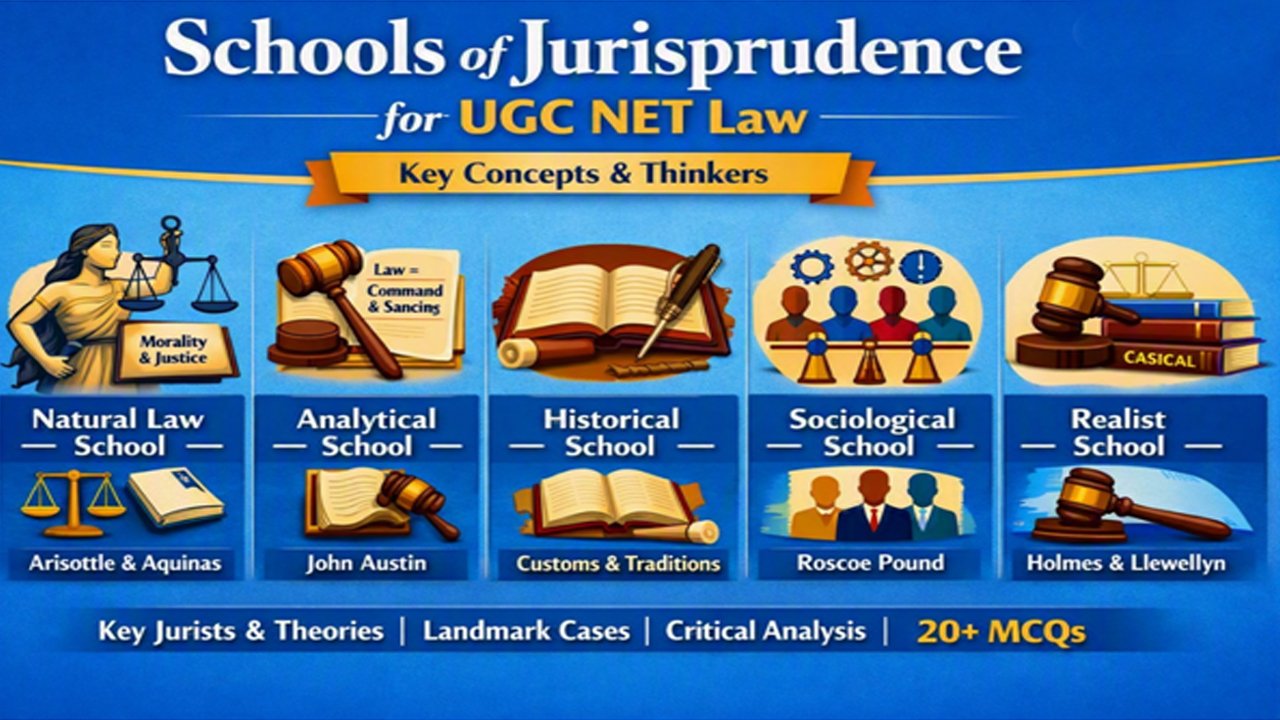
For aspirants of the UGC NET Law exam, mastering the Schools of Jurisprudence is essential. Jurisprudence forms the philosophical foundation of legal thought, explaining how law originates, evolves, and functions in society. Each school — from the Natural Law School’s moral foundation to the Analytical School’s sovereign command, from Savigny’s Historical Volksgeist to Roscoe Pound’s Sociological engineering, and finally the Realist School’s focus on judicial behavior — represents a distinct approach to defining law. These theories are not just academic; they are frequently tested in UGC NET through conceptual questions, case‑based analysis, and MCQs. A clear understanding of the fathers of each school, their core ideas, criticisms, and practical relevance will help candidates write high‑scoring answers and strengthen their jurisprudential base.
Natural Law School-
- Father: Aristotle (early foundation), later developed by St. Thomas Aquinas.
- Core Idea: Law is rooted in morality and reason. An unjust law is not a true law.
- Thinkers & Contributions:
- Aristotle: Law is reason free from passion.
- Aquinas: Distinguished between eternal law, natural law, and human law. Human law must conform to natural law.
- Grotius: Secularized natural law, arguing it exists even if God is denied.
- Criticism: Too idealistic; difficult to apply in modern pluralistic societies.
Analytical School-
- Father: John Austin (Imperative Theory of Law).
- Core Idea: Law is the command of the sovereign backed by sanctions. Morality is separate from law.
- Thinkers & Contributions:
- Jeremy Bentham: Utilitarianism — law should maximize happiness.
- John Austin: Law = command of sovereign + sanction.
- Criticism: Ignores morality and social context; too rigid.
- Exam Angle: MCQs on sovereignty, command, sanction, and separation of law from morality.
Historical School-
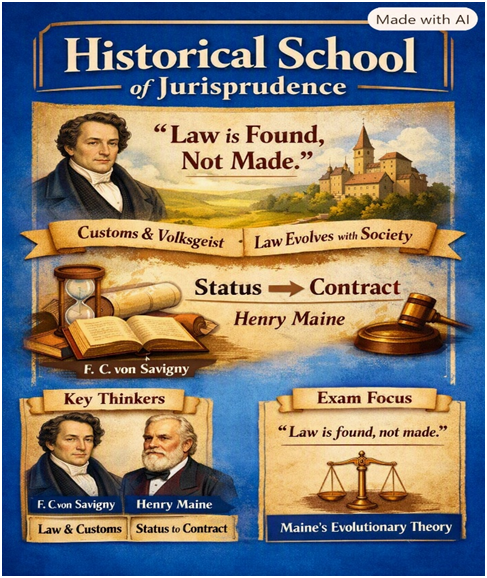
- Father: Friedrich Carl von Savigny.
- Core Idea: Law is not created but discovered; it evolves from customs and the spirit of the people (Volksgeist).
- Thinkers & Contributions:
- Savigny: Law grows with society, not imposed by rulers.
- Henry Maine: Law evolves from status to contract.
- Criticism: Overemphasis on customs; neglects legislative role.
Sociological School-
- Father: Roscoe Pound (though roots in Comte’s sociology).
- Core Idea: Law is a social institution designed to balance interests and engineer society.
- Thinkers & Contributions:
- Roscoe Pound: Law as social engineering — balancing individual, social, and public interests.
- Ihering: Law protects social interests; struggle is essential for law’s development.
- Criticism: Risk of law becoming too utilitarian, ignoring individual rights.
Realist School-
- Father: Oliver Wendell Holmes Jr. (American Realism).
- Core Idea: Law is not abstract rules but what courts actually do in practice.
- Thinkers & Contributions:
- Holmes: “The life of the law has not been logic; it has been experience.”
- Karl Llewellyn: Focused on judicial behavior and practical outcomes.
- Criticism: Too pragmatic; risks undermining consistency of law.
Landmark Case References for Schools of Jurisprudence-
A. Natural Law School-
- Kesavananda Bharati v. State of Kerala (1973) – Established the Basic Structure Doctrine, reflecting natural law principles of justice and constitutional supremacy.
- Maneka Gandhi v. Union of India (1978) – Expanded Article 21, holding that procedure must be “just, fair and reasonable,” aligning law with morality.
B. Analytical School-
- A.K. Gopalan v. State of Madras (1950) – Early interpretation of Article 21, treating law as sovereign command, consistent with Austin’s imperative theory.
- ADM Jabalpur v. Shivkant Shukla (1976) – During Emergency, upheld sovereign power over individual liberty, reflecting analytical positivism.
C. Historical School-
- Golaknath v. State of Punjab (1967) – Emphasized continuity of constitutional rights, echoing the idea that law evolves with society.
- Indira Nehru Gandhi v. Raj Narain (1975) – Reinforced democratic traditions and customs as part of constitutional law.
D. Sociological School-
- Vishaka v. State of Rajasthan (1997) – Introduced guidelines against workplace harassment, showing law as social engineering to protect social interests.
- MC Mehta v. Union of India (1987 onwards) – Environmental jurisprudence cases applying sociological principles like polluter pays and absolute liability.
E. Realist School-
- D.K. Basu v. State of West Bengal (1997) – Laid down guidelines against custodial violence, showing law as what courts enforce in practice.
- Justice K.S. Puttaswamy v. Union of India (2017) – Recognized privacy as a fundamental right, reflecting judicial behavior shaping law.
MCQs on Schools of Jurisprudence-
1. Who is considered the father of Analytical School?
A. Bentham
B. Austin
C. Savigny
D. Holmes
→ B. Austin
2. “Law is found, not made” is attributed to:
A. Savigny
B. Pound
C. Grotius
D. Maine
→ A. Savigny
3. Which school emphasizes law as social engineering?
A. Natural
B. Analytical
C. Sociological
D. Realist
→ C. Sociological
4. Who said “The life of the law has not been logic; it has been experience”?
A. Holmes
B. Austin
C. Bentham
D. Savigny
→ A. Holmes
5. Natural Law School aligns law with:
A. Sovereignty
B. Morality
C. Sanctions
D. Customs
→ B. Morality
6. The concept of Volksgeist is central to:
A. Analytical School
B. Historical School
C. Sociological School
D. Realist School
→ B. Historical School
7. “Law is the command of the sovereign” is the principle of:
A. Natural Law
B. Analytical School
C. Sociological School
D. Realist School
→ B. Analytical School
8. Who secularized natural law by stating it exists even without God?
A. Aquinas
B. Grotius
C. Aristotle
D. Savigny
→ B. Grotius
9. The utilitarian principle “greatest happiness of the greatest number” was given by:
A. Austin
B. Bentham
C. Pound
D. Maine
→ B. Bentham
10. The theory of law evolving from status to contract was proposed by:
A. Savigny
B. Maine
C. Holmes
D. Pound
→ B. Maine
11. Which school focuses on judicial behavior and practical outcomes?
A. Realist
B. Analytical
C. Historical
D. Natural
→ A. Realist
12. Roscoe Pound described law as:
A. Command of sovereign
B. Social engineering
C. Volksgeist
D. Morality
→ B. Social engineering
13. Which school separates law completely from morality?
A. Natural
B. Analytical
C. Sociological
D. Historical
→ B. Analytical
14. “Law is reason free from passion” was said by:
A. Aristotle
B. Aquinas
C. Holmes
D. Austin
→ A. Aristotle
15. Which jurist emphasized struggle as essential for law’s development?
A. Ihering
B. Pound
C. Savigny
D. Bentham
→ A. Ihering
16. The phrase “law protects social interests” is associated with:
A. Holmes
B. Ihering
C. Austin
D. Grotius
→ B. Ihering
17. Which school is most criticized for being too idealistic?
A. Natural
B. Analytical
C. Historical
D. Realist
→ A. Natural
18. Which school is most criticized for ignoring morality?
A. Analytical
B. Sociological
C. Historical
D. Realist
→ A. Analytical
19. Which school is most criticized for overemphasis on customs?
A. Historical
B. Sociological
C. Natural
D. Realist
→ A. Historical
20. Which school risks undermining consistency of law due to pragmatism?
A. Realist
B. Analytical
C. Sociological
D. Natural
→ A. Realist
Conclusion-
The Schools of Jurisprudence highlight different ways of understanding law — morality in the Natural School, sovereign command in the Analytical School, customs in the Historical School, social interests in the Sociological School, and judicial practice in the Realist School. For UGC NET Law, knowing the fathers, core ideas, and criticisms of each school is vital, as exam questions often demand comparison and critical analysis. A solid grasp of these theories ensures strong conceptual answers and better performance in jurisprudence‑based questions.
Frequently Asked Questions (FAQ) – Schools of Jurisprudence (UGC NET Law)-
John Austin, known for the Imperative Theory of Law.
It emphasizes that law evolves from customs and traditions, reflecting the Volksgeist (spirit of the people).
Roscoe Pound, the leading figure of the Sociological School.
Law is not abstract rules but what courts actually do in practice, focusing on judicial behavior.
Hugo Grotius, making natural law independent of divine authority.
“Law is found, not made.”